Specifying a Bridge Bearing Pad for 50 Years of Service: Rubber Grade, Shape Factor, and the Temperature Chart Most Buyers Skip

Views : 32
Update time : 2026-09-01 13:58:24
A practical decision guide to Bridge Bearing Pad specification: rubber grade selection, shape factor calculation, thermal movement planning, and procurement checkpoints for long-span structures.
The 50-Year Bearing Does Not Exist — But the 50-Year Specification Does
No manufacturer will guarantee a bridge bearing pad​ for half a century. Rubber ages, loads change, and environmental exposure is never exactly what the design assumed. But there are bridges in service today with elastomeric bearings that have passed their 40th anniversary without replacement. The difference between those structures and the ones that fail at year seven is not the rubber. It is the set of decisions made before the purchase order was issued.
This article walks through those decisions in the order they should be made: climate assessment, rubber selection, shape factor calculation, thermal movement planning, and the procurement checkpoints that lock in the design intent.

Decision 1: What Is the Actual Climate at the Bearing Elevation?
Most bridge specifications cite ambient air temperature from weather station data. But the bearing does not live at the weather station. It lives 5 to 10 meters above ground, under a deck that radiates heat in summer and sheds snowmelt in winter. The microclimate at the bearing seat is what matters.
Three questions to answer before selecting rubber grade:
Lowest sustained temperature for more than 72 continuous hours?​ This is the number that governs Grade selection per ASTM D4014. A brief overnight dip to -15°C does not require Grade 5; a week at -25°C does.
Is the bearing shaded or exposed?​ South-facing bearings in desert climates can see surface temperatures 15 to 20°C above ambient due to reflected heat from the deck soffit.
How close is saltwater or deicing spray?​ Chloride exposure alters both the rubber compound preference and the steel shim finish.

Decision 2: Rubber Grade — Not a Preference, a Calculation
ASTM D4014 defines Grade 0, 3, and 5 primarily by low-temperature stiffness behavior. The selection rule is straightforward:
Grade 0:​ Lowest one-day mean temperature above -10°C. Indoor or tropical applications only.
Grade 3:​ Lowest one-day mean temperature above -30°C. Covers most temperate and coastal climates.
Grade 5:​ Lowest one-day mean temperature below -30°C. Required for prairie, Nordic, and high-altitude installations.
But temperature is only half of the selection. The other half is ozone and UV exposure. For any outdoor installation, chloroprene (neoprene) is the correct polymer family because of its inherent ozone resistance. Natural rubber can be formulated to meet Grade 5 cold requirements, but it requires an antiozonant package that degrades over time. The maintenance cycle of a bridge does not always align with the depletion curve of a wax bloom.
Example:

A bridge in Harbin, China, sees winter lows of -35°C. A bridge in Singapore never drops below +20°C. Both need a bridge bearing pad, but the specifications are different:

Condition Harbin, CN Singapore, SG
Lowest one-day mean temp -32°C +21°C
Rubber Grade per ASTM D4014 Grade 5 Grade 0
Recommended polymer CR or NR with low-temp formulation CR for ozone resistance
Shore A hardness 55–60 (softer for cold flex) 60±5 (standard)
Steel shim finish Galvanized Galvanized with epoxy topcoat for humidity


Decision 3: Shape Factor — The Number That Prevents Squeeze-Out
Shape factor S = loaded area ÷ perimeter-free area of one rubber layer. It determines vertical stiffness, rotational capacity, and whether the pad will extrude laterally under load.

Design guidance for typical highway girders:
S ≥ 4: Absolute minimum per AASHTO M251
S = 6 to 8: Recommended for standard simply supported spans
S > 8: Required for heavily loaded girders or when vertical deflection must be minimized
Worked example:
A 400 mm × 500 mm pad with a single rubber layer thickness of 10 mm:
Loaded area = 400 × 500 = 200,000 mm²
Perimeter-free area = (2 × 400 + 2 × 500) × 10 = 18,000 mm²
Shape factor S = 200,000 / 18,000 = 11.1
That S value is high enough for heavy load but may be too stiff for bridges with significant rotation. Lower the S by increasing rubber layer thickness. The point is simple: the shape factor must be calculated for each pad configuration. It is not a number that can be carried from one project to another.

Decision 4: Thermal Movement — Size the Shear, Not the Plan Area
The horizontal movement of a bridge due to temperature change is:
Δ = α × L × ΔT
Where:
α = coefficient of thermal expansion (approximately 1.17×10⁻⁵ m/m/°C for concrete, 1.2×10⁻⁵ for steel)
L = expansion length from fixed point to free end
ΔT = design temperature range, adjusted for construction temperature at installation
Example:
A 30-meter concrete span with a 50°C design temperature range and installation at mid-range:
Δ = 1.17×10⁻⁵ × 30,000 mm × 25°C = 8.8 mm
That 8.8 mm is the horizontal displacement the bearing must accommodate in shear. Total rubber thickness must be at least:
tr ≥ Δ / 0.5 = 8.8 / 0.5 = 17.6 mm
This is why thinner total rubber thickness means less movement capacity. A pad specified purely for vertical load may fail in shear on the first major temperature swing.

Decision 5: Steel Shim Layout — The Quiet Load-Bearer
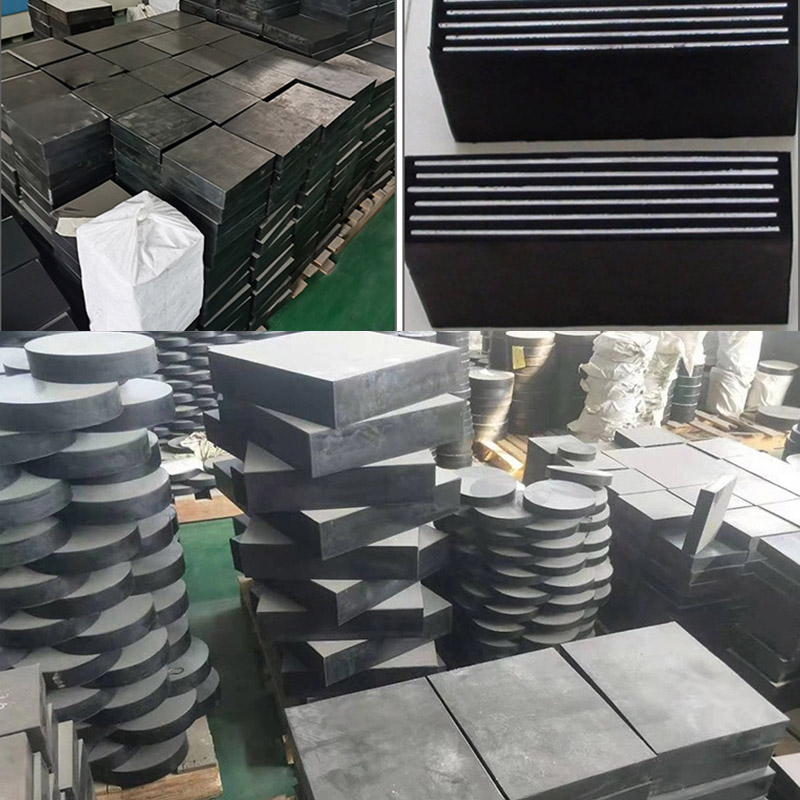
Internal steel shims do not carry vertical load directly. They prevent the rubber from bulging sideways, which allows the pad to carry load in compression instead of failing in tension at the edges.
Specification guidance:
Shim thickness: minimum 1.9 mm (14 gauge) internal, 2.6 mm (12 gauge) external
Shim material: ASTM A36 or A1011, hot-dip galvanized per ASTM A123
Shim cover: minimum 5 mm rubber over internal shims, 8 mm over external edges
Shim spacing: consistent throughout the laminate stack to ensure uniform stiffness
A pad with correct shim layout visually appears to be mostly rubber. In reality, the shims occupy 20% to 30% of the total height for heavily loaded bearings.

Decision 6: Procurement Checkpoints That Protect the Design
The best specification fails if procurement does not enforce it. The following checkpoints should appear in the purchase order, not just the design document:
Chemical test report​ for each lot: tensile strength, elongation, compression set, hardness
Ozone chamber test certificate​ for CR compound per ASTM D1149 if the pad is Grade 3 or higher
Peel test certificate​ for rubber-to-shim bond, minimum 10 kN/m
Mill certificate​ for steel shims confirming grade and galvanization
Cross-section photograph​ of a sample pad from the same production run, showing shim position and rubber cover thickness
Third-party inspection​ at the factory before shipment, with photos and dimensional measurements
A Cheap Insurance Policy: The Reference Sample

For every order above 50 pads, request one extra pad from the same production run and store it in a dry, shaded location. This is the reference sample. If a dispute arises at any point during the service life, this pad provides an unbiased baseline for material testing. It costs the price of one bearing and saves the cost of an arbitration.

What to Spec
A bridge bearing pad​ lasts fifty years only when the specification is built from site-specific data, not from the supplier's catalog. Calculate the shape factor for the actual girder dimensions. Select the rubber grade from the site's low-temperature record. Size the total rubber thickness from the thermal movement calculation. Require test certificates for every production lot. And keep a reference pad in storage. The process adds two days to the procurement schedule and removes the entire category of "unexpected early failure" from the project risk register.
Related News
Read More >>
How Bridge Bearing Pad Standards Have Changed in 20 Years — and What Your Next Specification Must Include How Bridge Bearing Pad Standards Have Changed in 20 Years — and What Your Next Specification Must Include
Sep .09.2026
A review of how Bridge Bearing Pad specifications evolved from simple rubber blocks to engineered laminated components. What changed in ASTM D4014, AASHTO, and EN 1337, and what buyers must update now.
Plain vs. Steel-Laminated Bridge Bearing Pad: Which One Belongs on Your Structure? Plain vs. Steel-Laminated Bridge Bearing Pad: Which One Belongs on Your Structure?
Sep .07.2026
A side-by-side engineering comparison of plain and steel-laminated bridge bearing pad designs. Load limits, rotation capacity, movement tolerance, and when each type is the correct choice.
We Replaced Our Bridge Bearing Pad Twice in Ten Years. The Third Time, We Changed the Spec Instead. We Replaced Our Bridge Bearing Pad Twice in Ten Years. The Third Time, We Changed the Spec Instead.
Aug .31.2026
A first-person account of a bridge bearing pad procurement failure: what cracked, what corroded, what we missed in the initial specification, and how we fixed it permanently.
How Do You Verify a Bridge Bearing Pad Will Perform for 30 Years Before Installation? How Do You Verify a Bridge Bearing Pad Will Perform for 30 Years Before Installation?
Aug .26.2026
Practical quality checks for Bridge Bearing Pad procurement: factory testing, material certification, dimensional inspection, and field acceptance criteria for infrastructure buyers.