

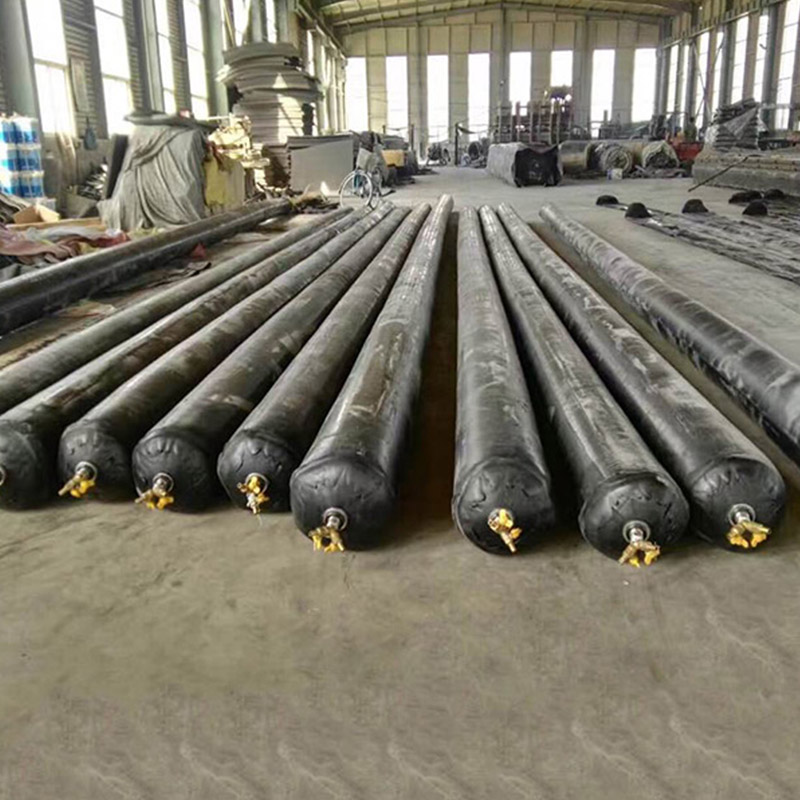
Most problems with a rubber inflatable concrete formwork are not visible when the bag is delivered. It arrives folded, looks heavy-duty, passes a quick inflate test in the yard. Then it goes into a reinforced cage, the concrete comes, and the hollow slab comes out wrong: top wall thin, inner face wavy, corners honeycombed, rebar showing.
The bag gets blamed. Usually the spec was too soft before the bag ever reached the site.
Here are five field problems that repeat across bridge hollow slabs, precast culverts, and box-girder cores — and what each one really means.
1. The core floats up during the pour
You set the inflated mandrel at the right elevation. Halfway through the pour, the inner void sits too high. Top concrete cover shrinks, bottom wall gets thick, sometimes the top rebar is barely covered.
Root cause:
Field rule: for hollow slabs, don’t rely on the bag’s weight. Use top pressure bars or scheduled tie points, pour in stages, and keep the feed point low. If the inner void drifts more than the drawing tolerance, the slab section is already non-compliant — patching the surface does not fix it.
2. Pressure bleeds off mid-cure, the void collapses locally
The gauge was fine at inflation. Two hours later a section of the inner wall is sunken, like the bag partially let go.
Root cause:
Field rule: inflate dry before every pour. Run the bag to working pressure, shut the valve, watch 10 minutes. Any drop means find the leak. A bag that needs re-pumping during initial set will leave a wavy or collapsed inner profile.
3. Honeycomb and exposed rebar on the inner face
Honeycomb on the outer soffit gets the attention. Honeycomb on the inner void is the inflatable-mandrel signature — and it usually traces back to the flexible wall moving during vibration.
Root cause:
Field rule: keep vibrators off the bag, set cover blocks so rebar never rides the rubber, and match slump to the section. If the inner face looks like a gravel wall, the mandrel was treated like a steel form — it isn’t.
4. Wavy inner wall that matches the tie-bar spacing
This one fools inspectors. The inner surface isn’t rough from bad concrete — it has regular waves, and the wave pitch equals the anti-float bar spacing.
Root cause:
Field rule: a little deformation is normal; a repeating corrugated inner surface is not. It means the bag’s reinforcement schedule is too light, or the anti-float system is brute-forced instead of engineered. The fix is in the RFQ, not the vibrator.
5. Bag goes hard, sticky, or cracks after a few jobs
A good mandrel runs many cycles. A bad one gets stiff after three jobs, picks up concrete, tears at the seam, or shows surface checking from UV and ozone.
Root cause:
Field rule: storage is part of the spec. Rinse, dry, shade, no oil, no solvent release agents. For outdoor/long-project use, ask for neoprene/EPDM-blend or anti-ozone compound, not just “natural rubber + fabric.”
What to put in the RFQ so the slab comes out right
What buyers should remember
A rubber inflatable concrete formwork is not a balloon you blow up and pour around. It is a pressure vessel made of rubber and cord fabric, fighting buoyancy, concrete head pressure, vibration, and sharp steel for the whole set time.
Most bad hollow slabs come from four soft spots:
no pressure-vs-diameter table
no anti-float plan
wrong compound for the site
RFQ that says “inflatable rubber mandrel as per supplier standard”
Write the ten lines above, and the supplier either quotes a mandrel that survives the pour — or tells you upfront that they can’t.
 Rubber Inflatable Mandrel vs Steel / Wooden Core Form: When the Bag Actually Saves Money
 Successful Participation in WindEnergy Hamburg 2026
 Steel-Faced Laminated Rubber Bumper: 5 Field Problems Buyers Keep Finding After Installation
 Rubber Laminated Loading Dock Bumper with Steel Angle: 5 Field Failure Signs That Point Back to the RFQ
