Field failure signs for rubber laminated loading dock bumpers with steel angle: bent angle, bond-line opening, flange-edge tearing, anchor pull-out, wrong compound. RFQ lines that stop substitution.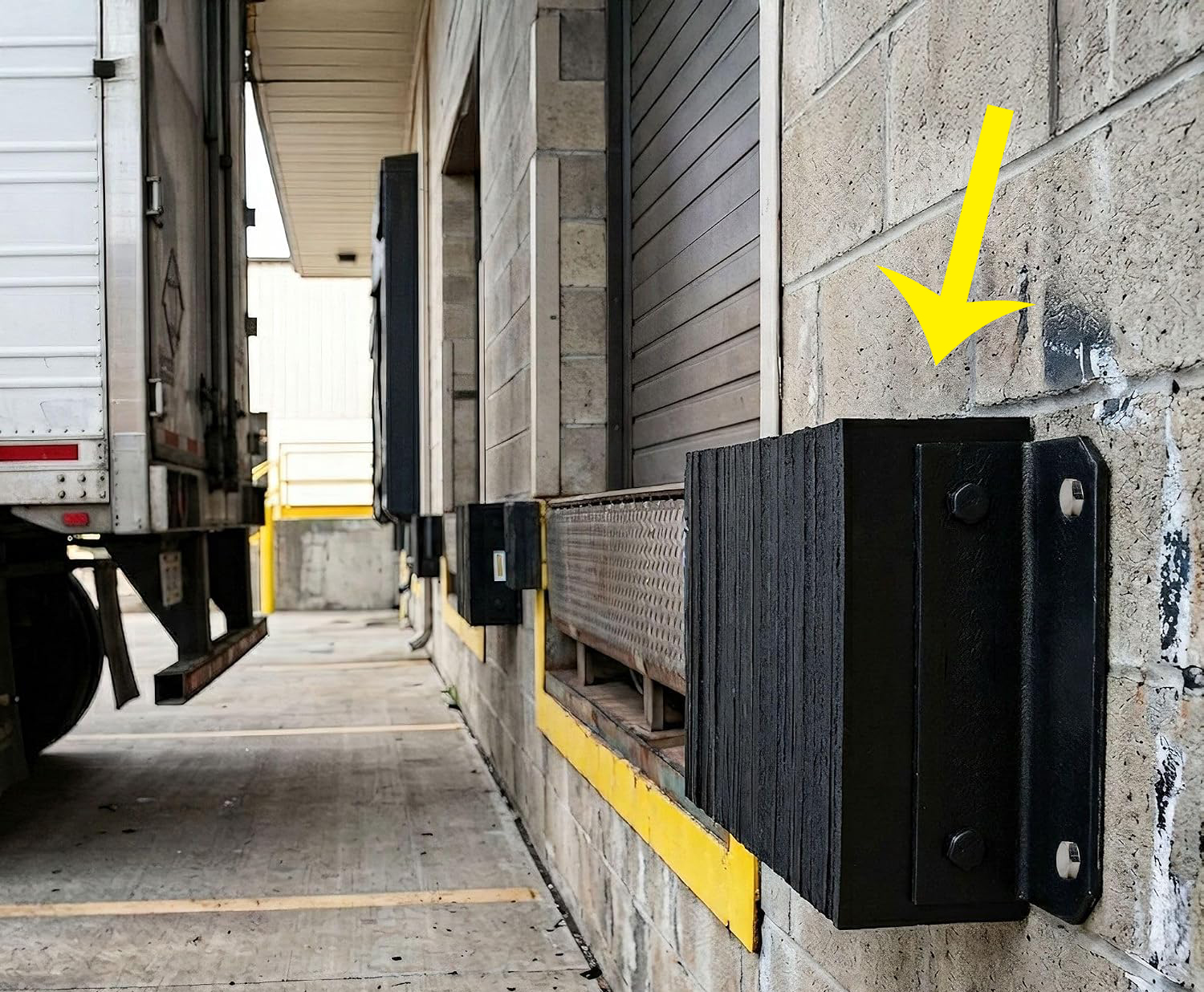
A Rubber Laminated Loading Dock Bumper with Steel Angle is not just a rubber pad bolted to a wall. It is a load-distribution assembly: layered rubber absorbs impact, internal steel shims control deflection, and the external steel angle transfers the reaction force into the dock structure.
When these fail prematurely — often in 6 to 12 months instead of 3 to 5 years — the rubber gets blamed. In most cases, the RFQ allowed the angle steel or the bond to be compromised.
Here are the 5 field signs that tell a buyer the spec was too soft.
Sign 1: The Steel Angle Bent or Twisted
The rubber still has thickness, but the steel angle bowed outward or the vertical leg twisted. The whole bumper tilts.Root cause:
- Angle thickness too thin (e.g., flat bar substituted for true structural angle)
- No continuous anchor pattern; bolts spaced too far apart
- Standard mild steel used in coastal/salt-air yards (rusted from inside out)
- Impact force exceeded the angle's moment capacity because projection was too long
Field rule: bent angle = structural mounting problem, not a rubber problem. Fix the substrate and upgrade the angle spec before swapping the bumper.
Sign 2: Rubber Pulled Away from the Angle Base
You see a gap opening between the rubber block and the inner face of the steel angle. The bolts are tight, but the assembly acts loose.Root cause:
- Adhesive system wrong for the rubber compound
- Steel angle not blast-cleaned before molding (oil/rust/mill scale on the metal)
- Water got in through a surface crack and reached the bond line
- Reclaimed rubber used in the laminate — bond consistency drops
Field rule: bond-line opening is a retirement condition. One bumper like that means check the whole batch by batch number. If the supplier can't show a peel/bond test for that lot, you've found why.
Sign 3: Corner Tear at the Angle Flange Edge
The rubber chunks out exactly at the outer edge of the angle iron flange, leaving a clean tear line matching the steel profile.
Root cause:
- Sharp, unrounded angle edges acting as a knife during impact
- Rubber compound too hard (Shore A too high) for the impact energy
- No fillet radius specified at the angle inner corner
- Angle iron cut with torch (rough burrs) instead of clean shearing/sawing
Field rule: if tears follow the steel edge, the steel prep was wrong. Specify radius corners and deburred edges in the RFQ.
Sign 4: Anchor Bolts Pulling Concrete, Angle Rocking
The rubber and angle look fine, but the unit rocks when pushed. Bolts spin or concrete crumbles around the sleeve.
Root cause:
- Weak/repaired concrete at the dock wall
- Anchor embedment too shallow
- Angle holes punched oversize at the factory (slop in the hole)
- Bumper projection too long, creating high leverage on the anchors
Field rule: tighten test first. If the bolt spins, don't torque harder. Core-drill new holes away from the old ones, or weld/bolt the angle to a structural backing plate. Anchors alone cannot carry a heavy laminated bumper if the angle flexes.
Sign 5: Premature Rubber Hardening or Checking (Site Mismatch)
Bumper installed outdoors, in a freezer, or near seawater. Survives summer, then starts cracking vertically or turns glass-hard in cold.
Root cause:Root cause:
- Generic NR/SBR blend quoted for every site
- No low-temp compound for freezers (neoprene/EPDM blend required)
- No galvanized angle/hardware for salt/chemical exposure
- UV and ozone ignored for outdoor docks
Field rule: if the bumper is outdoors or in extreme temps and nobody asked about compound grade, the spec was incomplete. The angle protects the mount; the compound protects the life.
9 RFQ Lines That Stop Substitution on Angle-Backed Bumpers
"Steel angle: continuous structural angle iron (not corner plates/flat bar), min thickness stated by load, hot-dip galvanized after cutting/drilling."
"Angle prep: blast-cleaned before molding, inner corners radiused, edges deburred. No torch-cut rough edges."
"Rubber compound: specify neoprene / EPDM / NR blend by site — freezer, outdoor, coastal, washdown."
"Laminate bond: peel/bond test per lot (min 10 kN/m); no reclaimed rubber without approval."
"Anchor pattern: continuous bolt spacing per load chart; oversize holes not permitted; washer/nut spec included."
"Projection: stated in mm/inch from dock face to rubber contact face, matched to trailer bed-height range."
"Hardware: galvanized or stainless per environment; zinc-plated only for indoor dry."
"Marking: model, compound, batch number, date, manufacturer on the angle."
"Reference sample: one unit from the production lot retained by buyer for dispute resolution."
What Buyers Should Remember
A Rubber Laminated Loading Dock Bumper with Steel Angle fails at its weakest link: usually the bond to the angle, the thickness of the angle, or the anchor into the wall.
Most premature failures aren't rubber quality alone. They're:
-
- Wrong angle thickness / steel grade
- Wrong compound for the site
- Wrong anchor spacing
- Wrong RFQ allowing substitution
Fix those four, and the bumpers stop being a quarterly replacement item.

 Bridge Bearing Pad Field Failure: 5 Visual Signs Before It Retires (And What Caused It)
 Bridge Bearing Pad RFQ Checklist: 9 Lines That Stop Suppliers From Subbing the Rubber
 Laminated Rubber Bearing: Maintenance and Inspection Protocols
 Elastomeric Bearing Pad: NR vs. CR Material Selection Guide