

Two-Way Protection: Why Your Trailers Need a Laminated Rubber Dock Bumper Too
Most dock bumper discussions focus on building protection. But there is another side to the equation: the trailer. A poorly designed or degraded bumper can cause significant damage to trailer rear frames, door hinges, and lighting assemblies. The Laminated Rubber Dock Bumper with steel corner reinforcement offers a unique advantage — it protects both your facility and the vehicles that service it.
The Hidden Cost of Aggressive Bumpers
Standard solid rubber bumpers, especially those that have hardened with age or UV exposure, behave more like rigid blocks than cushions. When a trailer backs into a hardened bumper, the impact energy does not get absorbed — it transfers directly into the trailer structure. Over time, this causes:
Trailer Frame Fatigue: Repeated hard impacts weaken welds and cause micro-cracks in the rear frame cross members.
Door Misalignment: The energy transfer can distort trailer door frames, causing binding, air leaks, and premature seal failure.
Light and Reflector Damage: Vibrations from hard impacts loosen or break tail lights, marker lights, and reflective tape, creating safety hazards and compliance issues.
Suspension Component Stress: The shock wave travels through the trailer chassis, accelerating wear on suspension bushings and spring hangers.
How Laminated Construction Softens the Blow
The progressive compression characteristic of a laminated bumper is the key to reducing trailer damage. Because each rubber layer compresses independently, the bumper decelerates the trailer gradually rather than stopping it abruptly.
Consider what happens inside a laminated bumper during a trailer impact:
Initial Contact: The outermost rubber layer compresses first, beginning to absorb energy at a low force level.
Mid-Stage Engagement: As the trailer pushes deeper, successive layers engage, each adding resistance incrementally.
Full Compression: At maximum deflection, all layers are engaged, providing the necessary stopping force without the spike that occurs when a solid bumper bottoms out.
This gradual ramp-up of resistance means the trailer experiences a smooth deceleration rather than a sudden stop. The peak force transmitted to the trailer frame is significantly reduced.
Steel Corners: Preventing Trailer Abrasion Damage
The steel corner plates serve a protective function for trailers as well. When a trailer backs in at an angle, the corner of the bumper contacts the trailer's side panel or rear frame. On an all-rubber bumper, this contact point can grip and drag across the trailer surface, creating paint scratches and metal abrasion.
The steel corner plate on a quality Laminated Rubber Dock Bumper presents a smooth, hard surface that allows the trailer to slide along it without grabbing. This reduces:
*Paint and decal damage on trailer sides.
*Abrasion marks on aluminum or stainless steel trailer panels.
*Snagging of trailer mud flaps and wiring harnesses.
Field Observations from Fleet Operators
Trucking companies that service facilities with laminated bumpers report measurable differences in trailer condition:
Reduced Lighting Repairs: Trailers regularly serviced at docks with laminated bumpers require fewer tail light and marker light replacements compared to those servicing docks with aged solid rubber bumpers.
Fewer Door Alignment Issues: Trailer mechanics note that rear door adjustments hold longer when trailers primarily use docks equipped with progressive-compression bumpers.
Less Cosmetic Damage: Fleet managers observe less paint scuffing and panel scratching on trailers using docks with steel-cornered bumpers versus all-rubber alternatives.
Selecting the Right Bumper for Trailer-Friendly Protection
When prioritizing trailer preservation, focus on these bumper characteristics:
| Characteristic | Benefit for Trailers |
| Lower durometer rubber (Shore A 65-70) | Softer initial contact reduces peak deceleration force |
| High laminate count (12+ per inch) | Smoother force progression during compression |
| Smooth steel corner finish | Prevents paint abrasion and panel scratching |
| Full-face contact surface | Distributes load evenly across trailer rear frame |
| Consistent thickness across entire face | Ensures uniform contact regardless of trailer bed height variation |
Installation Height Considerations for Trailer Protection
Bumper mounting height directly affects how impact forces transfer to the trailer. Follow these guidelines to minimize trailer stress:
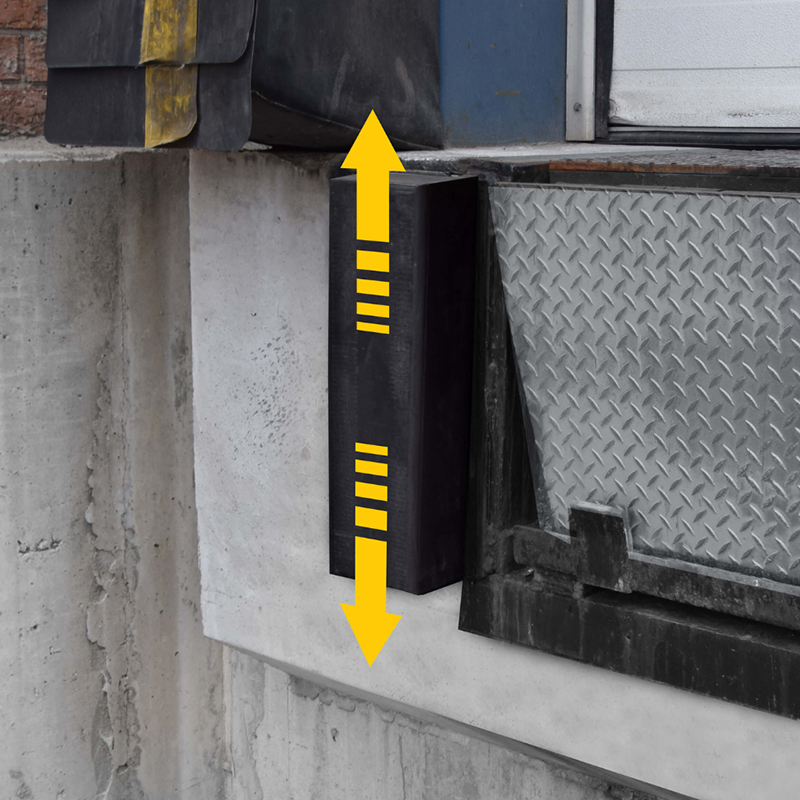
Match Common Trailer Bed Heights: Install bumpers so their center aligns with the average trailer bed height of your fleet. This ensures the bumper contacts the trailer's reinforced rear frame rather than the lighter side panels.
Avoid Overhanging Bumpers: Bumpers that extend above or below the trailer contact zone can catch on trailer components during angled approaches. The bumper face should align cleanly with the trailer's impact surface.
Use Continuous Bumper Runs: For docks with multiple doors, install continuous runs of bumpers rather than individual pads. This prevents trailers from catching on gaps between separate bumpers.
The Role of Bumper Surface Texture
Surface texture influences how the bumper interacts with trailer surfaces:
Smooth Face: Preferred for facilities handling painted or finished trailers. Reduces friction and prevents marring.
Textured Face: Provides additional grip for trailers on inclined docks or in wet conditions. However, the texture can abrade trailer paint over time.
Ribbed Design: Offers a compromise, providing some grip while limiting contact area to reduce abrasion.
Most Laminated Rubber Dock Bumpers with steel corners feature a smooth or lightly textured face, balancing grip requirements with trailer protection.
Long-Term Benefits for Fleet Relationships
Facilities that demonstrate concern for trailer condition build stronger relationships with carriers and fleet operators. Installing bumpers that protect both the dock and the vehicles sends a clear message about operational professionalism. Carriers notice which facilities treat their equipment well and often prioritize those locations for deliveries.
Conclusion
The Laminated Rubber Dock Bumper with steel corner reinforcement is not just a building protector — it is a trailer preservation tool. Its progressive compression reduces the shock forces that damage trailer frames and components, while the smooth steel corners prevent abrasive damage during angled approaches. For facility managers who value both their infrastructure and the equipment of the carriers they serve, this bumper design delivers two-way protection that strengthens the entire supply chain.
 How Much Load Can a Bridge Bearing Pad Actually Carry? Engineering Data for Safe Girder Support
 Is Your Bridge Bearing Pad Specified for the Wrong Rubber Grade? Why Elastomeric Bridge Bearing Pad Selection Decides 50-Year Deck Life
 Can a Loading Dock Bumper Survive -30°C Winters and +50°C Summers? Here Is the Extreme-Weather Data
 Are Your Dock Bumpers Specified for the Wrong Impact Profile? Why a Loading Dock Bumper with a Steel Face Outperforms in Real Traffic